
Satisfied Clients














Award Winning Products VIEW ALL SECURITY PRODUCTS


StormGARD®
A one-time investment that offers a lifetime of enhanced protection from mother nature's deadly forces.
SEE MORE
ScratchGARD®
Resists attacks from knives, acid etching and paint - protecting your costly glass.
SEE MORE
VehicleGARD®
Functions like an invisible coat of armor, defending against theft, carjacking, vandalism, and minor ballistic attacks.
SEE MORE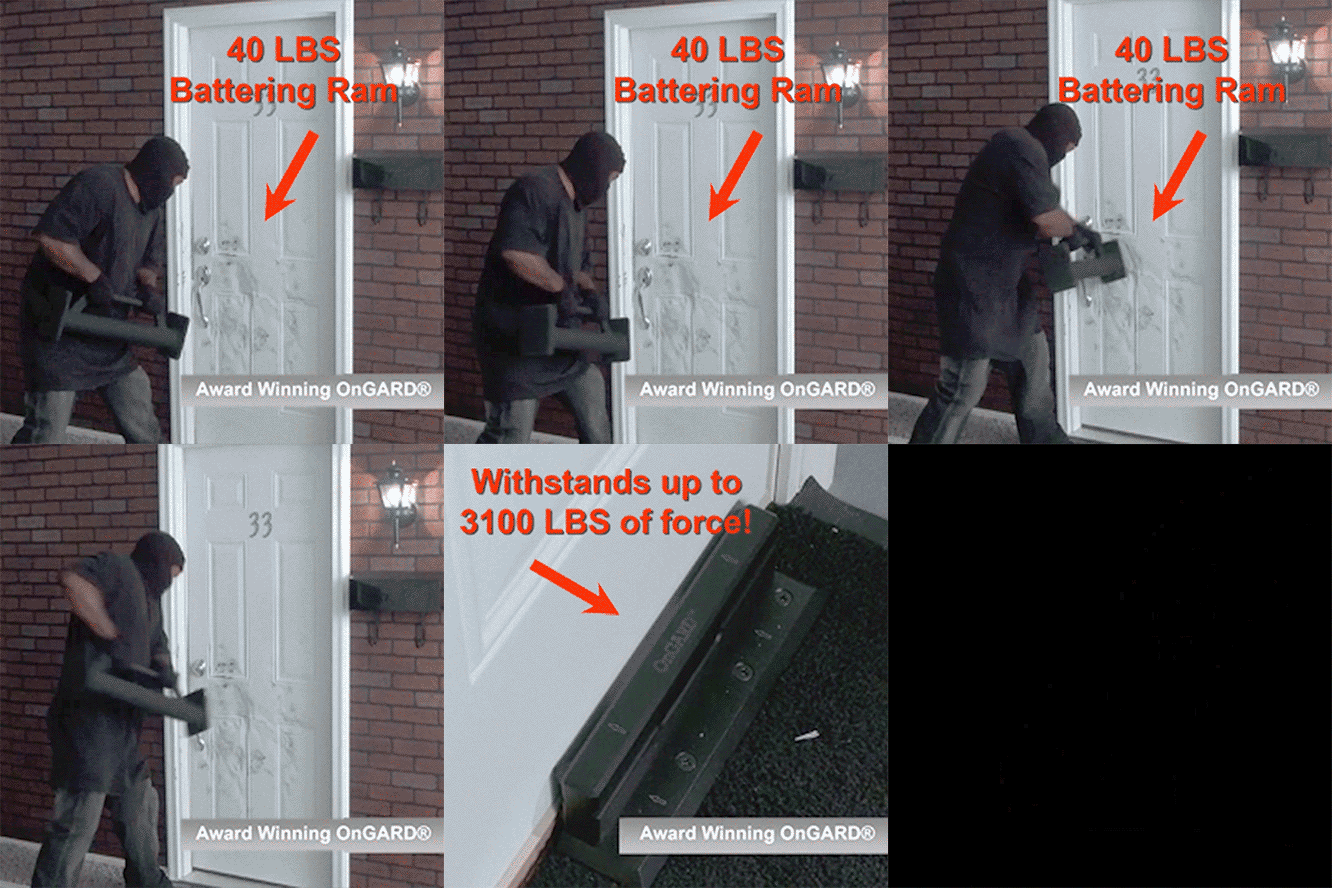
FREE OnGARD® Security Door Brace with Every ShatterGARD Installation
Prevent Violent Home Invasions
SEE MOREStormGARD®
A one-time investment that offers a lifetime of enhanced protection from mother nature's deadly forces.
SEE MORE
ScratchGARD®
Resists attacks from knives, acid etching and paint - protecting your costly glass.
SEE MOREVehicleGARD®
Functions like an invisible coat of armor, defending against theft, carjacking, vandalism, and minor ballistic attacks.
SEE MORECustomer Testimonials
ScratchGARD®
I was sick and tired of replacing costly windows at my pet store. ScratchGARD saved me a bundle.
Marge. N
ScratchGARD®
My agency applied ScratchGARD film to our city bus stops to defend against graffiti and vandalism. Couldn`t be happier.
Watson. M
ScratchGARD®
Fantastic price and super professional installation. Happy customer
Dee. S
ScratchGARD®
I became sick and tired of replacing our costly windowpanes at my hardware store. ScratchGARD was an excellent investment.
Murry. G
ScratchGARD®
Short & sweet, ScratchGARD saved my agency thousands of dollars in damaged train windows.
Laura. D
ScratchGARD®
Upon arriving to my store, we found windows covered in paint. Luckly, we had ScratchGARD applied months prior. All we had to do was peel away the sacrificial film to expose the undamaged windows. Huge cost saver.
Steven. L
BlastGARD®
Amazing installation experience and the warranty makes you believe it really works! Hope to never find out though : )
H. Perkins
BlastGARD®
I am a campaign manager in a politician’s office and last year we had a Molotov cocktail tossed through our front window. Two weeks later we got BlastGARD.
R. Marchese
BlastGARD®
As a government contractor I’ve seen a lot of products that claim to work under the worst human conditions. Most of them are crap but this is the real deal.
J. Lenihan
BlastGARD®
The installation = top notch! Loooove the finished product -- no one seeing my building for the first time would ever notice the window film! Image is important. Test. Test.
S. Donovan
BlastGARD®
I’m the owner of an insurance agency and just had this installed on our office windows. I strongly urge other business owners to go the same – the benefits far outweigh the cost, which is surprisingly affordable.
E. Tarmin
BlastGARD®
Safe and looks great, just like glass.
F. Confino
BlastGARD®
Next day installation by the nicest guys… Roberto & Tom, you’re the best.
S. Massa
BlastGARD®
You can’t put a price on human life but if you could, this is the price to beat!
D. Beck
BlastGARD®
I run a preschool and we had this product installed last week – you can’t be too careful when dealing with kids!
K. Daniels
BlastGARD®
Our church board of directors just approved installing this product – we pray we’ll never need it but you never know!
B. Patterson
BlastGARD®
Our store is right near an air force base and there are times the glass windows rattle and shake from the jet take-offs. Having BlastGARD on the windows makes me hopeful they won’t shatter one of these days!
M. Davenport
BlastGARD®
My tax office is on the same block as a government office building – best thing my boss did was to install this to help prevent damage and injuries. We’re all a little nervous these days.
L. Repetto
BlastGARD®
I operate an abortion clinic and the health and well being of my patients is paramount. Enhancing the safety of my office is something I do regularly and this product was key part of my recent upgrade
A. Meyers
BlastGARD®
I served in the Army and was deployed overseas and you won't see a better product than BlastGARD available to the public.
T. Lewy
BlastGARD®
I purchased BlastGARD the day after the bombing of the Pittsburgh synagogue – nowhere is safe anymore.
C. Gallo
VehicleGARD®
Simple to install – took less than two hours! Can’t tell there’s anything there.
M. Kline
VehicleGARD®
I’m installing this on my fleet of yellow cabs – people are crazy!
K. Fallon
VehicleGARD®
My pharmacy delivers. My drivers know not to leave the car unattended with prescriptions inside but there are times when they’re outside the car. This helps me prevent smash and grabs.
E. Krieger
VehicleGARD®
I’m a surgical device sales rep and my equipment is both expensive and proprietary. I can’t protect my car enough!
W. Martin
VehicleGARD®
After getting ripped off AGAIN, I added window films to all of my contractor vans. So tired of having to replace materials – costs me time and money.
J. Levy
VehicleGARD®
I’m a security guard in a gated neighborhood and we just got these installed on our cars – it was really fast and not noticeable.
B. Munoz
VehicleGARD®
I sell products at flea markets so my truck is my storage unit. This product was a small price to pay – much cheaper than an insurance claim!
A. Pado
VehicleGARD®
I’m a Lyft driver and got this installed because my car is my business. I can’t take chances, I got bills to pay.
S. Haas
VehicleGARD®
Our daughter turns 16 next month and will get her driver’s license so we got this installed last week. There’s nothing more important to us than her safety.
R. Coleman
VehicleGARD®
I’m a repair guy for a big electronics retailer and my boss added this to our vehicles to help prevent break ins – super cool product!
C. Han
VehicleGARD®
As a law enforcement officer I was leery about this product but I have to say it works! I’ll be getting it on my personal vehicles too.
D. Wyman
VehicleGARD®
I invested every penny of my savings into my food truck and everything inside is brand new. There’s no way I’m taking any chances so I installed the security film to the windows.
R. Garcia
VehicleGARD®
I have a plumbing business and our vans get broken into a lot. Equipment is expensive so we added this product to the fleet – fingers crossed no break ins yet.
V. Cavallo
VehicleGARD®
I go to school full-time and work part-time so I have tons of valuable stuff in my car. Adding this makes me confident everything will still be there at the end of the night.
J. Sullivan
VehicleGARD®
As a mom with two young kids who shuttles everywhere for sports and activities -- at all hours of the day and night! -- I feel much safer. Anything that helps protect my family gets my mom vote ok.
G. Merced
BurglarGARD®
If you own your own business you can’t afford NOT to have this product.
M. Frew
BurglarGARD®
Our high-end boutique sees a lot of window shoppers and we worry some are actually “casing” the store. The glass protection film plus our alarm helps stop thieves and more importantly, keeps our inventory inside the store!
K. Leland
BurglarGARD®
Our gas station sees a lot of petty violence, mostly from drunks. But it causes a lot of damage and scares employees. Having the security film makes us feel safer and lets us stay open.
C. Healy
BurglarGARD®
My elderly mom lives in an area where kids terrorize the older residents. Installing this gives us reassurance since she lives there alone.
I. Hernandez
BurglarGARD®
We had this installed right before the holidays and didn’t have to close the store! This is amazing since I have a gift shop and it was prime shopping season.
W. Greene
BurglarGARD®
Our home was broken into last month and the sheriff suggested we get something like this to help prevent another burglary. I`m for anything that helps protect my wife and kids.
S. Garner
BurglarGARD®
I’m a single woman living in a ground floor NYC apartment – there’s no way I’d sleep at night without this on my windows.
D. Nicolai
BurglarGARD®
You can’t beat price and warranty, worth every penny.
G. Collins
BurglarGARD®
I’m a loss prevention officer at a major retailer with electronics, cell phones and jewelry. My boss just approved this product and it’s getting installed next week – can’t wait.
E. O’Leary
BurglarGARD®
My bodega is near a big college and there’s lots of rallies. Having this film on my windows helps protect me from rocks and other stuff that gets thrown around.
H. Ramos
BurglarGARD®
I have a vacation house with a beautiful view of the lake. I want security since we are not there all the time but didn’t want to impact my view – this is perfect.
N. Scarnati
BurglarGARD®
I own a local pharmacy in a large city. Even with metal security gates, I get a lot of attempted break-ins and replace my glass windows a lot. Adding this glass film gives me bonus protection.
F. Ryan
BurglarGARD®
I'm a small business owner in changing neighborhood and can't afford a fancy alarm system. The security film protects my store and inventory and that saves me money and headaches.
A. Vazquez
BurglarGARD®
My money transfer company is a hot target for lowlifes looking for quick cash. This safety film is so affordable there’s no way I wouldn’t install it to protect my money and my people.
J. Simone
BurglarGARD®
Can't beat the professionalism of the sales team and installers... smart and polite. These guys know there stuff.
P. Cosenza
StormGARD®
Do it yourself affordable storm protection – sold.
J. Rucker
StormGARD®
I own a daycare center and we added this to our plate glass windows. Parents trust their kids to us so we need to prepare for everything, Mother Nature included!
S. Pressman
StormGARD®
We live in the northeast but have seen an increase in storms over the past 5 years. We applied this to our windows so when fast storms move through we’re ready.
P. Weinberg
StormGARD®
We live in tornado country and glass damage is pretty common. Anything we can do to protect our home Is worth it – bonus that I could install it myself!
K. Werner
StormGARD®
A tree branch hit my storefront window during a tropical storm. The glass cracked but didn't shatter so everything inside was still okay- if it wasn't I woulda been out of business.
H. Trouson
StormGARD®
I live in NC in an area not normally affected by hurricanes. But Florence was massive and I needed a fast solution to protect my home. Fortunately, my house and family were OK. Thanx guys.
M. Stamp
ShatterGARD Inc., the global leader in safety and security window films, is dedicated to safeguarding people and property worldwide. Commonly known as the Invisible Coat of Armor, ShatterGARD`s proprietary security window films provide a robust defense against burglaries, natural disasters, and explosions while maintaining your windows' aesthetic appeal. Whether you're looking to fortify your home, business, or building, ShatterGARD offers a tailored solution for you.
Since 1998, ShatterGARD, Inc. has manufactured and applied our award-winning safety and security window films globally. Our maintenance-free, highly scratch-resistant window films improve the overall structural integrity of any windowpane. In the unlikely event the window breaks, our proprietary film helps hold the razor-sharp shards of glass together, reducing the likelihood of window penetration by burglars, mother nature, or explosions. Applied by ShatterGARD-authorized technicians only, our window films are virtually undetectable and reduce the need for unsightly burglar bars or hurricane shutters. And unlike costly ballistic glass, ShatterGARD™ safety and security window films are guaranteed not to yellow or distort over time.
What makes a good window protection film?
Essentially there are three important ingredients that will ensure the performance of the product..

High Quality Raw Materials
ShatterGARD is one of the leading and most respected window film providers in the world. All films utilized are subject to stringent testing and carefully inspected prior to leaving the plant. Our firm markets only 1st grade security and safety window films. We are proud to attach our name to such a high quality product. For this reason, ShatterGARD is proud to offer the only lifetime film and labor replacement warranty in the industry.

The Adhesive System
The adhesive is a critical part of any ShatterGARD window film. The adhesive system not only provides the all-important bonding between the polyester film and the glass surface, it also incorporates an invisible ultra-violet inhibitor that rejects upwards of 98 % of the harmful rays that fade furnishings.

Professional Installation
ShatterGARD window films will only perform to specification if the installation is carried out by an expert installer. Unlike the inexperienced neighborhood window tinter, ShatterGARD technicians must undergo many hours of specialized training to install our security and safety films. Our technicians can apply our window films with absolutely no disruption to your home or business. There's absolutely no mess or odor.


